
Our Product for Smaller Satellites
Overview
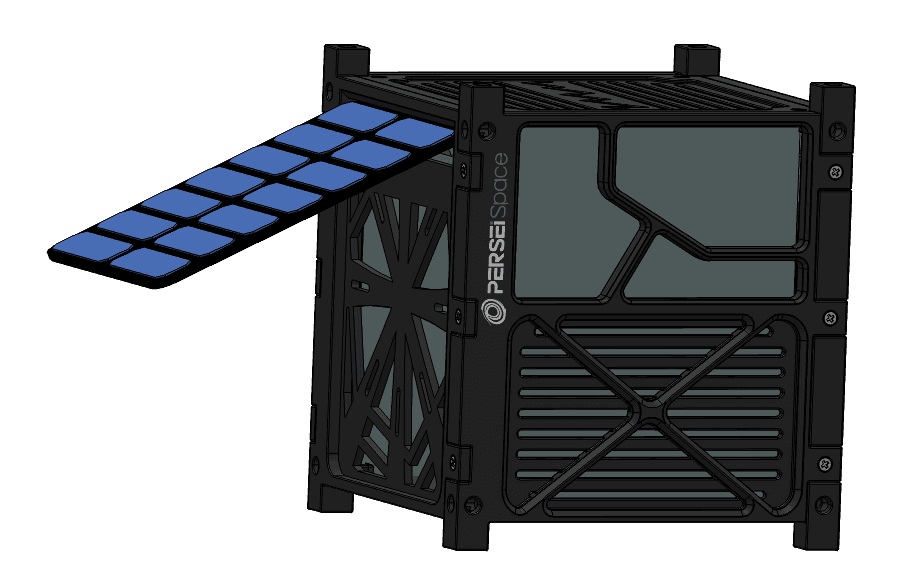
The Green Mobility Module (GMM) is a next-generation electrodynamic tether (ET) system currently being developed within the European Innovation Council (EIC) Pathfinder project E.T.COMPACT (2024–2027). The project aims to advance electrodynamic tether technology towards TRL 4 (Technology Readiness Level 4) by validating key innovations that will enable future in-orbit demonstrations and commercial applications. The intended 3U form factor of the Green Mobility Module (GMM) is a compact propellant-less deorbiting and propulsion system based on electrodynamic tether technology, designed for satellites in the 70–210 kg range. By interacting with Earth’s magnetic field, the system generates thrust or drag without consuming propellant, using electrical power harvested from the spacecraft’s solar arrays. The technology provides a sustainable alternative to conventional propulsion systems, eliminating the need to carry propellant while reducing mission mass and increasing operational flexibility. Within E.T.COMPACT, the following key innovations are being researched:
Innovations
Deorbiting + Propulsion
Unlike conventional electrodynamic tether systems designed exclusively for end-of-life disposal, the next generation of GMM technology is being developed to provide both deorbiting and in-orbit propulsion. By generating either drag or thrust through its interaction with Earth’s magnetic field, the system will enable controlled de-boosting, orbit maintenance (station-keeping), orbit re-boosting, orbital transfers, and other propellant-less mobility operations, significantly extending mission capabilities while reducing dependence on conventional propulsion systems.
Bare Photovoltaic Tether (BPT)
The project investigates a new generation of electrodynamic tethers capable of harvesting electrical power directly along the tether through integrated CIGS/perovskite photovoltaic technology. This concept enables the tether to become an active power-generating element, increasing overall system efficiency while reducing the spacecraft’s power burden and enhancing the performance of electrodynamic propulsion.
Reel-in / Reel-out capabilities
Advanced tether deployment and retrieval mechanisms are being developed to enable controlled reel-in and reel-out operations. These capabilities improve deployment reliability and dynamic stability while opening new operational possibilities, including collision avoidance manoeuvres, optimisation of tether length for different mission phases, enhanced electrodynamic performance, and improved spacecraft attitude and orbital control.
Highly integrated autonomous architecture
The project is developing a new autonomous system architecture that maximises integration with the host spacecraft by sharing avionics, power electronics, and onboard computing resources whenever possible. This approach reduces volume, mass, complexity, and cost, resulting in a more compact, lightweight, and easily integrable solution for future satellite platforms.
The final commercial Green Mobility Module will combine the proven technologies developed across PERSEI Space’s previous research programmes with the most promising innovations currently being validated within E.T.COMPACT. The final configuration will be tailored to customer requirements, offering the optimal combination of maturity, performance, integration level, and mission-specific capabilities for each application.
Green Mobility Module — specifications
Target application
- Target satellites
- 70 to 210 kg
- Orbits
- Low Earth orbit (LEO), all inclinations
- Applications
- End-of-life deorbiting, orbit maintenance, re-boosting
Hardware description
- Volume
- 3 U
- System mass
- 7 kg
- Power consumption
- 100 W
- Maximum thrust
- 10 mN (condition-dependent)
Technology and programme
- Power harvesting
- Bare Photovoltaic Tether (BPT) with CIGS/perovskite technology
- Programme
- EIC Pathfinder E.T.COMPACT (2024-2027), targeting TRL 4 by 2027
Use Cases
Suited to small low Earth orbit missions, such as Earth observation and technology demonstration satellites in the 70 to 210 kg class, that need end-of-life deorbiting, orbit maintenance, or re-boosting without a chemical propulsion system.
Interested in Green Mobility Module (GMM)?
Get in touch with our engineering team to request a detailed data sheet or discuss integration for your mission.
Contact our team