
Our Solution to Mitigate Space Debris
Overview
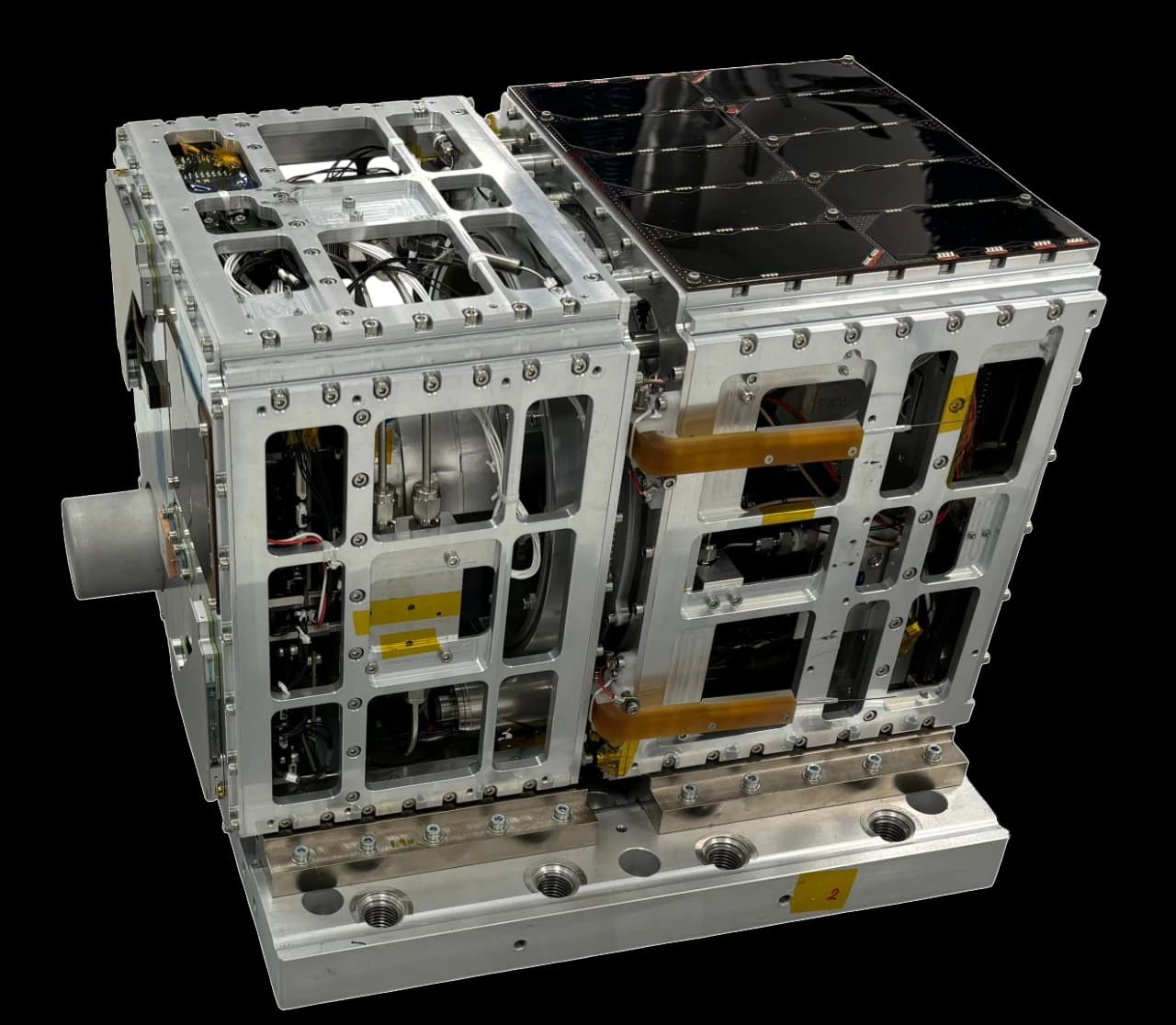
Autonomous Deorbit Devices (DDs) are compact subsystems designed to guarantee the post-mission disposal of space objects in low Earth orbit (LEO), aligned with increasingly strict regulatory deadlines. They can be integrated into satellites before launch, especially when missions must meet compliance rules (e.g. the U.S. FCC 5-year rule or ESA’s Zero Debris Approach). Alternatively, DDs can be deployed as payloads on in-orbit servicing (IoS) vehicles that install them on already existing, non-functional satellites or debris during active debris removal (ADR) missions. Thanks to their autonomous operation, DDs are especially useful for legacy satellites or debris that lack onboard propulsion or power. At the heart of these devices is the electrodynamic tether (EDT). Unlike other deorbiting technologies, EDTs make it possible to build subsystems that are fully autonomous: they generate their own power via small solar arrays, maintain communication through independent telemetry and telecommand, and perform attitude control (e.g. detumbling) without input from the host satellite. The same technology can also be implemented in a non-autonomous form for a more compact, lower-cost subsystem. The first prototype, E.T.PACK-F, was developed under the European Innovation Council (EIC) projects E.T.PACK and E.T.PACK-F. E.T.PACK produced the first functional prototype; E.T.PACK-F matured the technology toward flight readiness. The E.T.PACK-F unit is a 12U device with a total mass of 20 kg and a 420-meter electrodynamic tether, targeting host satellites over 200 kg. Its in-orbit demonstration is scheduled for 2027 and will be led by PERSEI Space, with support from the EC/ESA Flight Ticket Initiative. After the E.T.PACK-F demonstration, PERSEI Space plans PEARSON as its first commercial product: a longer tether (around 1 km), subsystems optimized for higher reliability and lower cost, and interfaces tailored to customer needs. Commercialization is targeted for 2027/2028, addressing medium to large objects such as satellites, upper stages, and payload adapters.
Characteristics
Propellant-less
The deorbit device uses the natural resources of the space environment to generate the deorbiting force.
Autonomous
The deorbit device does not require any input from the host object.
Collision avoidance capability
The Lorentz force can be turned on and off by telecommand.
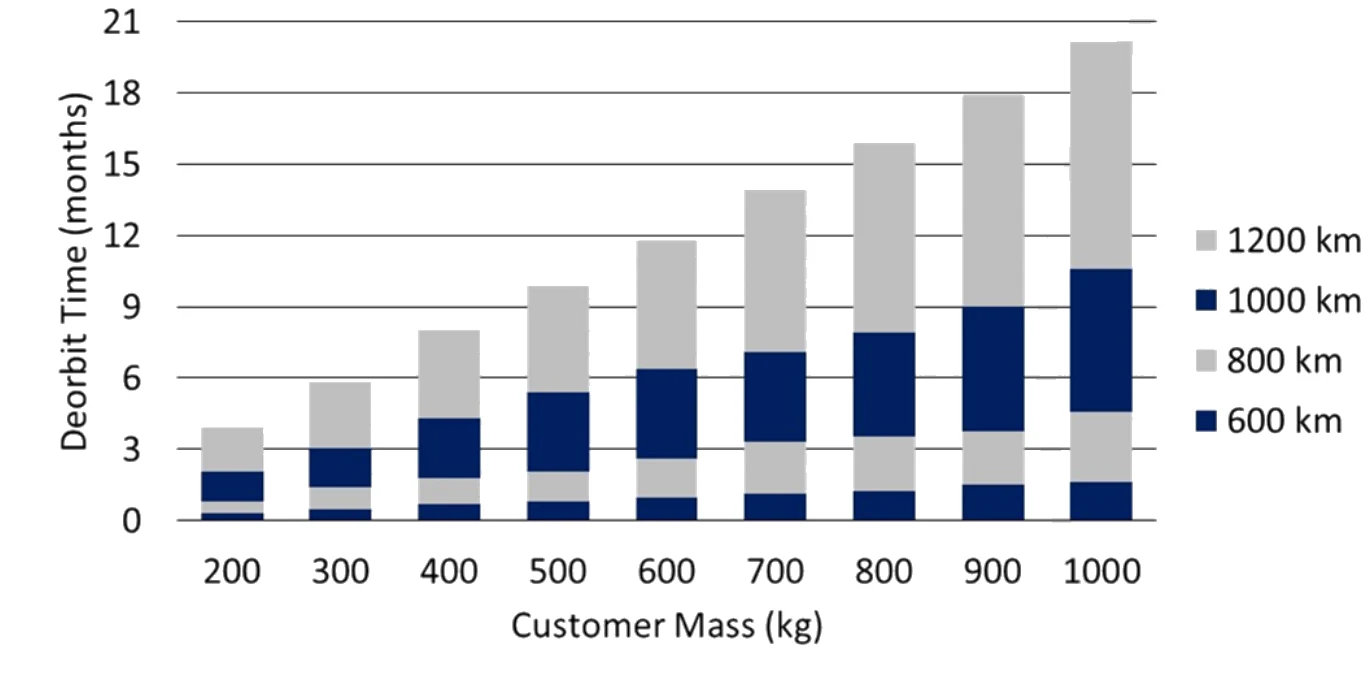
The expected performance of the system is illustrated below. As an example, a 100 kg satellite operating at an altitude of 800 km and an orbital inclination of 50° is expected to deorbit in approximately five months, comfortably complying with the most stringent international debris mitigation requirements, including the proposed five-year post-mission disposal guidelines.
E.T.PACK-F deorbit device — specifications
Hardware description
- Mass
- 20 kg
- Volume
- 12 U
- Modules
- Electron Emitter Module (EEM) and Deployment Mechanism Module (DMM)
EDT technology characteristics
- Length
- 420 m
- Material
- Aluminium
- Geometry
- Tape
- Electron emitter
- Hollow cathode
Elements included to achieve autonomy
- Power
- Solar panels on the DMM and EEM walls
- Communication
- UHF (DMM) and S-band (EEM) antennas
- Avionics
- OBC, ADCS and CDHS on the DMM and EEM
Key Features
- [✓]Autonomous operation: own solar power, independent telemetry/telecommand, and attitude (e.g. detumbling) without the host; non-autonomous option for a more compact, lower-cost design
- [✓]Application: deorbit. E.T.PACK-F prototype: 12U, 20 kg, 420 m tether; targets host satellites over 200 kg
- [✓]Host satellite class: from about 200 kg to 2 t (including PEARSON-class commercial line for medium-to-large objects and adapters)
- [✓]Pre-launch integration for compliance (e.g. the U.S. FCC 5-year rule or ESA Zero Debris), or delivery as a payload on in-orbit servicing (IoS) vehicles for active debris removal (ADR) on non-functional objects
- [✓]E.T.PACK-F in-orbit demonstration 2027, PERSEI Space, EC/ESA Flight Ticket; PEARSON from 2027/2028 with ~1 km tether and tailored interfaces
Use Cases
For operators who must demonstrate compliant end-of-life disposal, for constellations and single spacecraft integrated before launch, and for in-orbit servicing missions where a deorbit device is installed on an already-orbiting satellite or debris object (active debris removal). Suitable when the host is unpowered or uncontrolled, and for the medium-to-large assets that the upcoming PEARSON commercial line will serve.
Interested in Autonomous Deorbit Device (DD)?
Download the data sheet, or get in touch with our engineering team to discuss integration for your mission.
Download Data SheetContact our team