
Mission Analysis Software for Space Systems Deorbiting

Overview
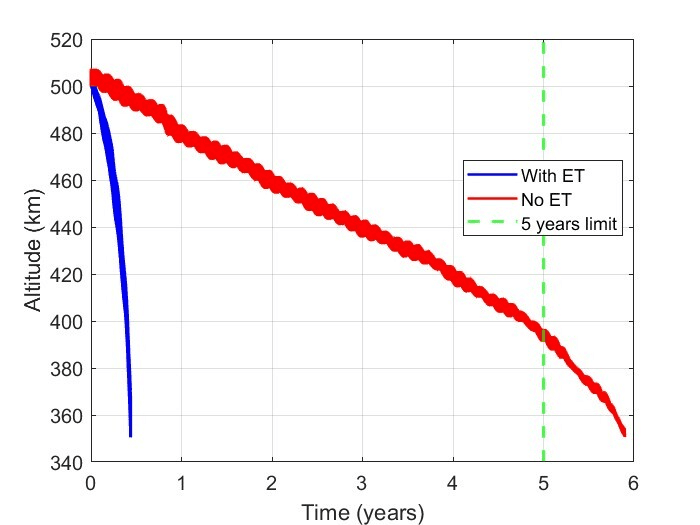
BETsMA (Bare Electrodynamic Tether Mission Analysis) is software for the analysis of missions with electrodynamic tethers. Users provide basic mission data: spacecraft mass, orbits, and the objective to be achieved with the electrodynamic tether (EDT), such as deorbiting, reboost, station-keeping, or power harvesting. Beyond the optimal tether configuration (cathode technology and tether dimensions), BETsMA v2.0 returns a full set of results: evolution of orbital parameters during the mission, electrical variables, forces, tether dynamics and thermal behavior, and safety considerations. The suite is also a strong research tool: it can simulate three electrodynamic tether types (bare, low-work-function, and bare-photovoltaic) with different dynamic models (point-like, multi-bar, and multi-particle) across a wide range of propulsive and power-harvesting scenarios. It delivers high-fidelity modeling of tether dynamics, plasma interactions, and orbital mechanics in low Earth orbit (LEO).
BETsMA v2.0 — specifications
Inputs and outputs
- Input
- Mission characteristics: spacecraft mass, orbits, EDT objectives
- Output
- Optimal EDT configuration: cathode technology and tether dimensions
- Results
- Orbital evolution, electrical variables, forces, dynamics, thermal behaviour and safety
Models
- Tether types
- Bare, low-work-function and bare-photovoltaic
- Dynamic models
- Point-like, multi-bar and multi-particle
- Scenarios
- Propulsive and power-harvesting, across many mission profiles
Use Cases
For satellite operators, space agencies, and mission planners sizing or validating electrodynamic tether missions, and for researchers studying tether electrodynamics, propulsion, drag, and power generation in low Earth orbit.
Interested in BETsMA v2.0?
Get in touch with our engineering team to request a detailed data sheet or discuss integration for your mission.
Contact our team