
ECO-Tethers consortium completes the Concept Key Point of the ESA sustainability system study
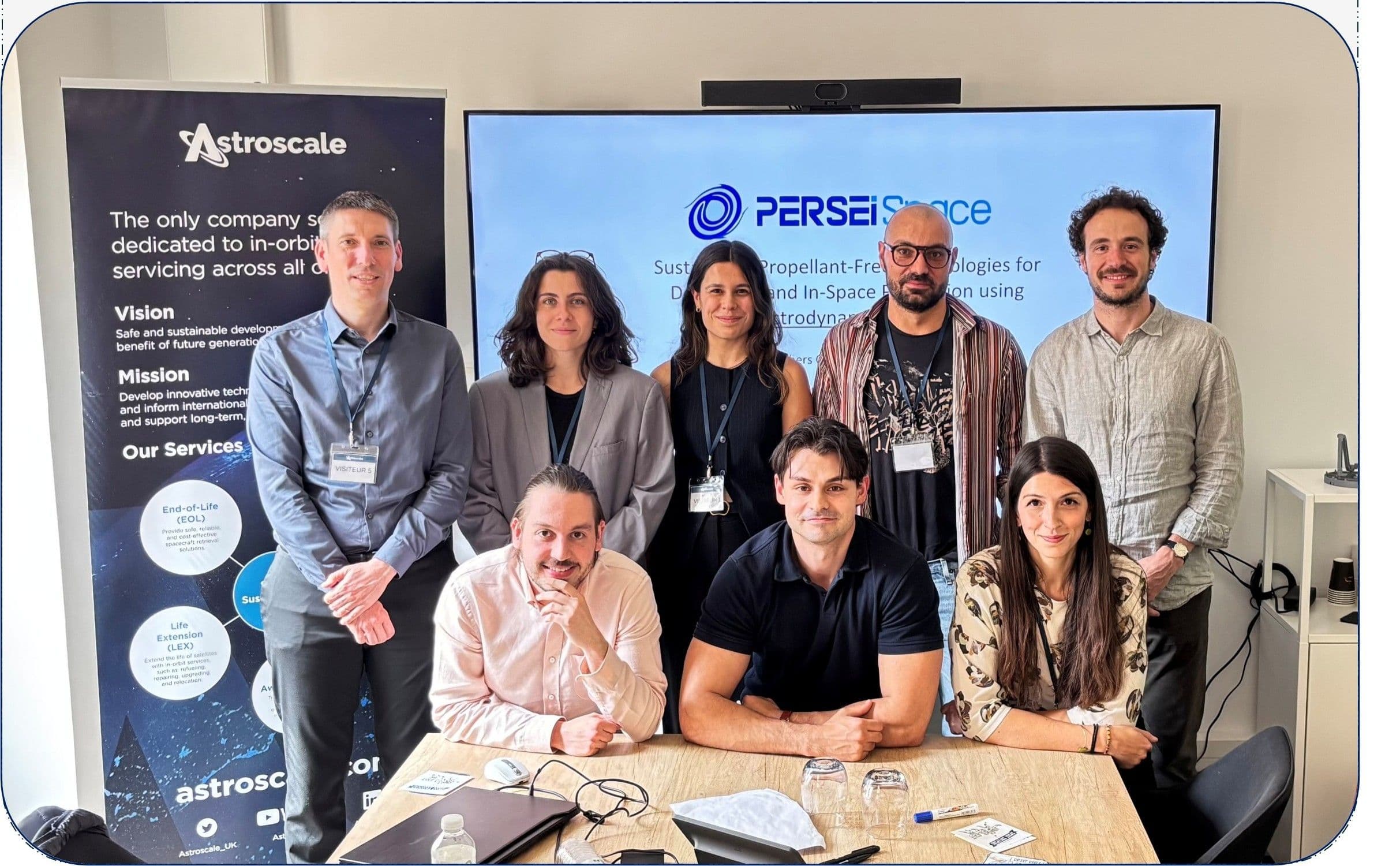
PERSEI Space, with Thales Alenia Space and Astroscale, closes Work Package 2 of the ESA-funded ECO-Tethers study on schedule
PERSEI Space, as prime contractor alongside partners Thales Alenia Space and Astroscale, has successfully achieved the Concept Key Point (CKP) for the ECO-Tethers system study commissioned by the European Space Agency. The milestone completes Work Package 2 and marks initial progress through Work Package 3, formally documented in the Definition and Justification File.
Since the study began, the consortium has focused on demonstrating that electrodynamic tethers can address orbital sustainability through a single propellant-free technology, enabling both reliable end-of-life disposal and flexible in-space mobility.
The team translated five distinct use cases into system-level requirements and Key Performance Indicators. Using PERSEI Space's BETsMA v2.0 mission-analysis software, developed from lessons learned in the E.T.PACK projects, it ran extensive parametric simulations across varying orbital altitudes, inclinations and spacecraft masses.
The five use cases are: satellite deorbiting through electrodynamic tether-based devices; launcher upper-stage and mission-related object deorbiting; satellite propellant-less propulsion for reboost and station-keeping; in-orbit servicing vehicle propulsion without propellant constraints; and active debris removal through "deploy-and-leave" autonomous kits. For each scenario, preliminary tether concepts were established, integration constraints assessed, and trade spaces defined for architecture selection.
"Reaching the Concept Key Point on schedule tells us that the vision we presented at kick-off holds up under real engineering scrutiny," said Jesús Manuel Muñoz Tejeda, CEO of PERSEI Space.
The consortium combines PERSEI Space's electrodynamic tether expertise with Thales Alenia Space's system integration capability and Astroscale's operational experience in in-orbit services, a combination that allowed the concepts to be stress-tested against realistic mission requirements.
The project now advances towards the Design Key Point, completing the parametric trade-offs needed to converge on preferred electrodynamic tether architectures for each use case. That work will include a detailed Life Cycle Assessment comparing the technology against existing alternatives.